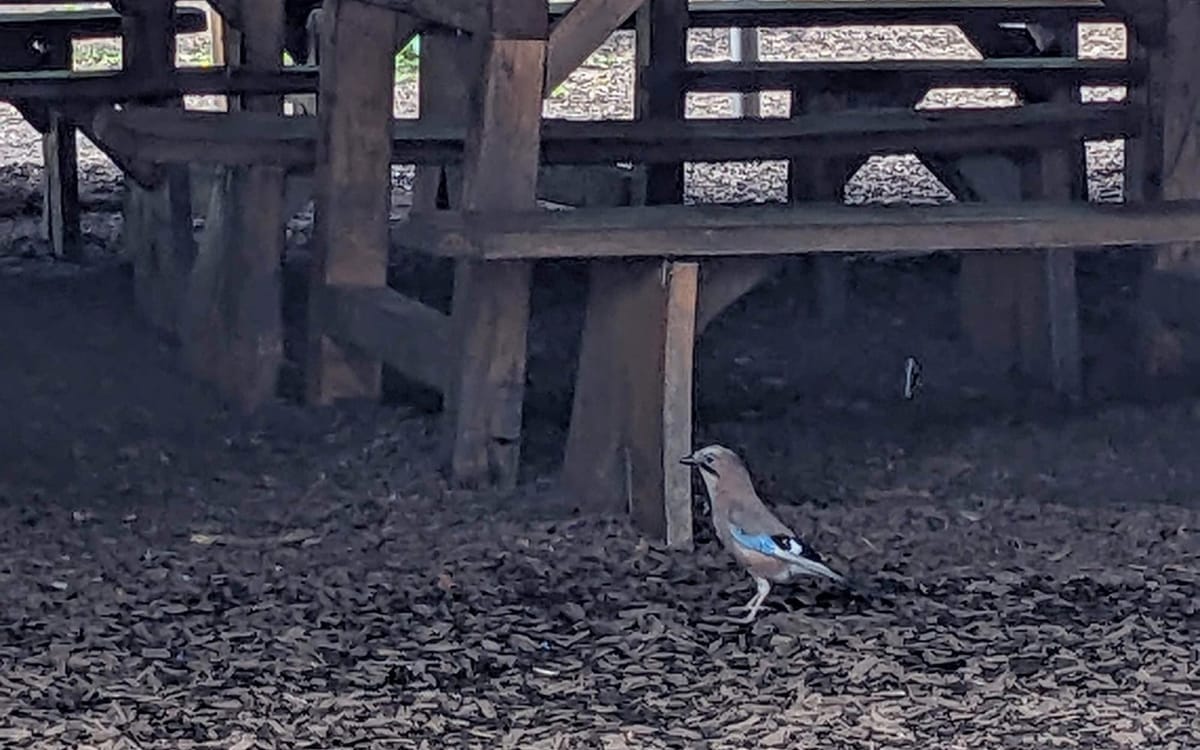
The jay as a messenger
Who knows what messages the jay may have for me.
I've had such a good reading month and there's still most of a week left!
One of my absolute highlights was The Fish Ladder by Katherine Norbury. It's everything I want in a book - honest depictions of nature, magical and mythical connections, familiar landscapes and an astonishing personal story. Since I've been focussed on hares and rabbits with my own writing, I was particularly drawn to her reference to a hare as a psychopomp. Isn't that a delicious word? It's Greek in origin and translates to "spirit guide". It appears across a number of faiths in relation to those who smooth the dead's transition into the afterlife, including Egyptian Anubis and the Norse Valkyries.
In Jungian psychology, it's not just the dead that benefit from this guidance as this definition denotes:
"Psychopomp: A psychic factor that mediates unconscious contents to consciousness, often personified in the image of a wise old man or woman, and sometimes as a helpful animal" (Sharp, 1991, p. 108)
Just as I was wondering whether there was an app for matching you with a suitable psychopomp, nature provided one. As I was diligently completing this year's Big Garden Birdwatch, a special visitor touched down in the chaotic stand of ash: a jay, my middle namesake. I intend to follow it to the forest at the soonest opportunity, listening carefully for any wisdom in its rasping, warbling and whispering. I've been writing about mimicry in corvids recently too and discovered jays can imitate buzzards, miaowing cats and even children's laughter. Who knows what messages they may have for me.
Sharp,D. (Ed.) 1991 Jung lexicon: A primer of terms & concepts